Quick answer: Yes, boiling tap water kills most bacteria, including common pathogens such as E. coli. Bringing water to a rolling boil for at least one minute is widely recommended as an effective way to inactivate most disease-causing bacteria and many other microorganisms. However, boiling does not address chemical contaminants, and some microorganisms such as Cryptosporidium and Giardia require additional treatment steps.

Why boiling works against most bacteria in tap water
Boiling is one of the oldest and most reliable methods for reducing bacterial contamination in drinking water. Heat denatures the proteins and disrupts the cell structures that bacteria depend on to survive and reproduce. When water reaches 100 degrees Celsius at sea level and is held at a rolling boil, the thermal energy is sufficient to inactivate the vast majority of bacteria that may be present.
One of the key indicator organisms used in Australian drinking water assessment is Escherichia coli (E. coli). According to the Australian Drinking Water Guidelines, thermotolerant coliforms are a sub-group of coliforms that are able to grow at 44.5 plus or minus 0.2 degrees Celsius. This heat tolerance is relevant to water testing, but it is well below the temperatures reached during boiling, which is why boiling is effective against these organisms.
The same guidelines note that thermotolerant coliforms that produce indole from tryptophan at 44.5 plus or minus 0.2 degrees Celsius are regarded as being E. coli. While most E. coli strains are non-pathogenic, the Australian Drinking Water Guidelines also state that there are some pathogenic subtypes that can cause enteric illness, including enteropathogenic, enteroinvasive, enterotoxigenic and enterohaemorrhagic strains. Boiling inactivates these pathogenic strains along with the non-pathogenic ones.
What boiling does not address in tap water
Boiling is effective against most bacteria, but it is not a solution for every water quality concern. There are several important limitations to understand before relying on boiling alone.
Cryptosporidium and Giardia
These protozoan parasites are more resistant to heat than most bacteria and require a sustained, vigorous boil to be reliably inactivated. For households concerned about these organisms, NSW Health states that an absolute 1 micron or smaller filter is necessary to remove Cryptosporidium and Giardia. Boiling alone may not be sufficient in all circumstances where these parasites are a concern.
Chemical contaminants
Boiling does not reduce chlorine, chloramine, heavy metals, or other dissolved chemical contaminants. In fact, boiling can concentrate some dissolved substances as water volume reduces through evaporation. If chemical contaminants are a concern in your water supply, boiling is not the appropriate treatment method for those issues.
Sediment and particulates
Boiling does not remove sediment, rust, or particulate matter from water. These require physical filtration rather than heat treatment.
How to boil water correctly for bacterial reduction
To get the most benefit from boiling as a bacterial reduction method, follow these practical steps.
- Use a clean kettle or pot and start with cold tap water.
- Bring the water to a full, rolling boil, not just a simmer.
- Hold the boil for at least one minute. At higher altitudes, where water boils at a lower temperature, a longer boil of two to three minutes is advisable.
- Allow the water to cool in a covered, clean container before drinking.
- Store boiled water in a clean, covered container and use it within 24 hours.
- Do not re-boil water repeatedly, as this can concentrate any dissolved minerals or chemical residues already present.
Boiling is most useful during a boil water advisory issued by your local water authority, after a natural disaster, or when travelling to areas where tap water quality is uncertain.
When is boiling tap water in Australia actually necessary?
Australian reticulated tap water is treated and monitored to meet the standards set out in the Australian Drinking Water Guidelines, which include testing for E. coli and thermotolerant coliforms using established methods such as the most probable number method and the membrane filtration method. Under normal conditions, treated municipal tap water in Australian cities and towns is considered safe to drink without boiling.
Boiling becomes relevant in specific circumstances, including:
- A formal boil water notice issued by your state or territory water authority or health department.
- After flooding or a natural disaster that may have compromised the water supply or household plumbing.
- In rural or remote areas where water comes from an untreated tank, bore, or surface water source.
- When travelling to regions where water treatment standards differ from those in Australia.
Outside of these situations, most Australian households on a reticulated supply do not need to boil their tap water for bacterial safety under normal conditions.
Bacteria and water filtration products
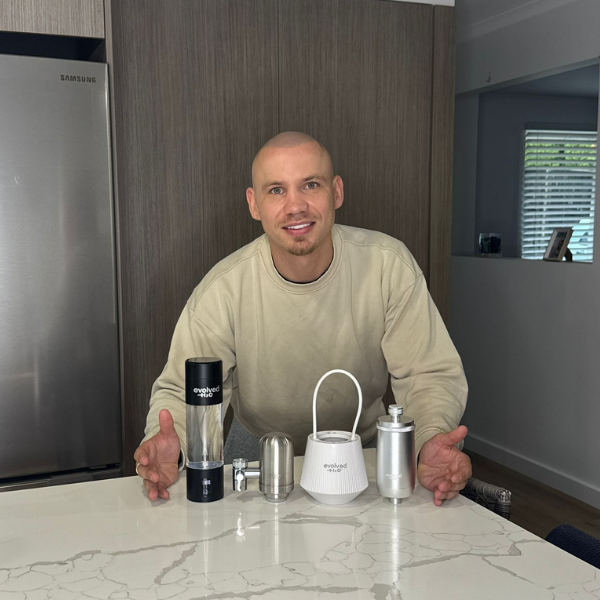
For households interested in filtration as part of their water routine, some Evolved H2O products carry specific claims for bacteria. The Evolved H2O Advanced Shower Filter removes bacteria from shower water. The Evolved H2O Advanced Bath Filter removes bacteria from bath water. The Evolved H2O 3.5L Glass Water Filter Jug reduces bacteria in drinking water.
These are the only Evolved H2O products with an approved bacteria claim. No claim is made for bacteria reduction for any other product in the range.
Key takeaways
- Boiling tap water kills most bacteria, including pathogenic strains of E. coli, by inactivating them through heat.
- A full rolling boil held for at least one minute is the recommended approach.
- Boiling does not address chemical contaminants such as chlorine, chloramine, or heavy metals.
- For Cryptosporidium and Giardia, NSW Health advises that an absolute 1 micron or smaller filter is necessary for removal.
- Under normal conditions, treated Australian municipal tap water does not require boiling for bacterial safety.
- Boiling is most relevant during a boil water advisory, after a natural disaster, or when using untreated water sources.
Frequently Asked Questions
Does boiling tap water kill all bacteria?
Boiling kills most bacteria found in tap water, including common pathogens such as E. coli. A full rolling boil held for at least one minute is sufficient to inactivate the vast majority of bacteria. Some highly heat-resistant spore-forming bacteria can survive boiling, but these are not typically a concern in treated municipal water supplies.
Does boiling water remove Cryptosporidium and Giardia?
Boiling can inactivate Cryptosporidium and Giardia if the water is brought to a vigorous boil and held there. However, NSW Health states that an absolute 1 micron or smaller filter is necessary to remove these parasites. If these organisms are a specific concern, filtration is the recommended approach alongside or instead of boiling.
Does boiling tap water remove chlorine or other chemicals?
No. Boiling is a heat treatment that targets microorganisms. It does not reliably reduce chlorine, chloramine, heavy metals, or other dissolved chemical contaminants. Boiling can actually concentrate some dissolved substances as water evaporates, so it is not appropriate as a chemical treatment method.
How long should I boil tap water to make it safe from bacteria?
Bring the water to a full, rolling boil and hold it there for at least one minute. At higher altitudes where water boils at a lower temperature, extend this to two to three minutes. A simmer is not sufficient. Allow the water to cool in a clean, covered container before drinking or storing.
Do I need to boil tap water in Australia?
Under normal conditions, treated municipal tap water in Australian cities and towns meets the standards of the Australian Drinking Water Guidelines and does not require boiling for bacterial safety. Boiling is recommended when your local water authority issues a boil water advisory, after flooding or a natural disaster, or when using water from an untreated tank, bore, or surface water source.
Is boiled water the same as filtered water?
No. Boiling and filtration address different concerns. Boiling inactivates most bacteria and some other microorganisms through heat. Filtration physically removes or reduces particles, sediment, and depending on the filter type, certain chemical contaminants. They are complementary approaches rather than direct substitutes for each other.
Sources
- Escherichia coli | Australian Drinking Water Guidelines (guidelines.nhmrc.gov.au)
- Drinking water and public health (NSW Health)