Quick answer: Mercury can be present in Australian tap water, but concentrations in major reticulated supplies are typically very low, usually less than 0.0001 mg/L, well below the national guideline value of 0.001 mg/L set by the Australian Drinking Water Guidelines. For most households, tap water mercury is not a day-to-day concern, though it is worth understanding what the guidelines mean and where mercury in water comes from.

What the Australian Drinking Water Guidelines say about mercury in tap water
The short answer is that Australian tap water is monitored against a clear national standard. According to the Australian Drinking Water Guidelines published by guidelines.nhmrc.gov.au, in major Australian reticulated supplies the concentrations of total mercury range up to 0.001 mg/L, with typical concentrations usually less than 0.0001 mg/L.
The same guidelines state that, based on health considerations, the concentration of total mercury in drinking water should not exceed 0.001 mg/L. This is the national guideline value that water authorities work to meet.
In practical terms, the typical concentration found in major supplies is around ten times lower than the guideline ceiling. That gap matters: it means the guideline is not a line that supplies routinely approach, but a protective upper boundary with meaningful headroom below it.
Where does mercury in water come from?
Mercury is a naturally occurring element found in the earth's crust, and it can enter water sources through both natural processes and human activity. Natural weathering of rock and soil releases small amounts of mercury into waterways. Industrial processes, historical use of mercury in mining, and atmospheric deposition from combustion sources can also contribute to environmental mercury levels.
Once mercury enters a water source, water treatment and distribution infrastructure can influence the concentration that reaches the tap. Major Australian water utilities monitor source water and treated water as part of their routine quality programmes, which is why the concentrations recorded in reticulated supplies are generally very low.
It is also worth noting that drinking water is not the primary route of mercury exposure for most Australians. The Australian Drinking Water Guidelines note that the average Australian adult dietary intake of mercury is approximately 0.004 mg per day, with food, particularly certain fish, being the dominant contributor to that figure rather than drinking water.
Who does the guideline value aim to protect?
The guideline value is set with the most vulnerable groups in mind. The Australian Drinking Water Guidelines state that the guideline value should be sufficient to protect pregnant women and nursing mothers, who are at greatest risk from the adverse effects of methyl mercury.
Methyl mercury is an organic form of mercury that can accumulate in the body and cross the placental barrier. Setting the guideline with this group in mind means it provides a conservative level of protection for the broader population as well.
If you have specific concerns about your health or the health of a family member, speak with a qualified health professional. This article is informational only and is not medical advice.
How is mercury measured in drinking water?
Water authorities use established analytical methods to test for mercury. The Australian Drinking Water Guidelines note that the concentration of total mercury in drinking water can be determined by the cold vapour atomic absorption method (APHA 3500-Hg Part B 1992). This is a sensitive laboratory technique capable of detecting mercury at the very low concentrations relevant to drinking water.
If you want to know the mercury levels in your local supply, your state or territory water authority publishes annual water quality reports. These reports are the most direct source of data for your specific area.
What about mercury reduction in drinking water at home?
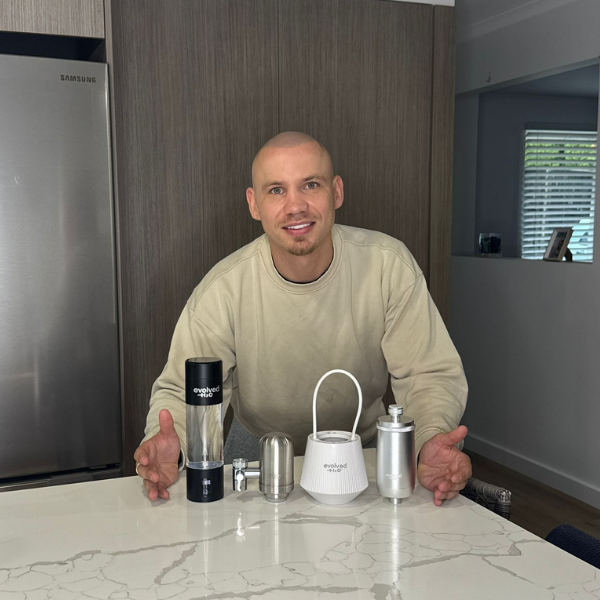
For households that want an additional layer of filtration for their drinking water, the Evolved H2O Glass Water Filter Jug reduces 95.5% of mercury. This is the only Evolved H2O product with an approved mercury reduction claim, and it applies to the 3.5L Glass Water Filter Jug specifically.
Key takeaways
- Mercury is present in Australian tap water at very low concentrations, typically less than 0.0001 mg/L in major reticulated supplies.
- The national guideline value, set by the Australian Drinking Water Guidelines, is 0.001 mg/L, giving a meaningful safety margin above typical measured levels.
- The guideline is designed to protect the most vulnerable groups, including pregnant women and nursing mothers.
- Food, particularly certain fish, is the dominant source of mercury exposure for most Australians, not drinking water.
- Your state or territory water authority publishes annual water quality reports with local data.
- The Evolved H2O 3.5L Glass Water Filter Jug reduces 95.5% of mercury for households seeking additional filtration for their drinking water.
Frequently Asked Questions
Is mercury in Australian tap water dangerous?
Concentrations in major Australian reticulated supplies are typically well below the national guideline value of 0.001 mg/L, with most supplies measuring less than 0.0001 mg/L. The guideline is set conservatively to protect the most vulnerable groups. For specific health concerns, speak with a qualified health professional rather than relying on general information.
What is the guideline limit for mercury in Australian drinking water?
The Australian Drinking Water Guidelines state that, based on health considerations, the concentration of total mercury in drinking water should not exceed 0.001 mg/L. This is the national benchmark that water authorities work to meet, and typical concentrations in major supplies are well below it.
Is food or tap water the bigger source of mercury exposure?
For most Australians, food is the dominant source. The Australian Drinking Water Guidelines note that the average adult dietary intake of mercury is approximately 0.004 mg per day, with certain fish being the main contributor. Drinking water typically accounts for a much smaller share of overall mercury intake.
Who is most at risk from mercury in drinking water?
The Australian Drinking Water Guidelines identify pregnant women and nursing mothers as the groups at greatest risk from the adverse effects of methyl mercury. The guideline value is specifically designed to be protective for these groups. Anyone with specific health concerns should seek advice from a qualified health professional.
How do I find out the mercury level in my local tap water?
Your state or territory water authority publishes annual drinking water quality reports that include data on trace metals including mercury. These reports are freely available online and give the most accurate picture of what is in your local supply. You can also contact your water utility directly to request monitoring data.
Does the Evolved H2O Glass Water Filter Jug reduce mercury?
Yes. The Evolved H2O 3.5L Glass Water Filter Jug reduces 95.5% of mercury. This is the specific Evolved H2O product with an approved mercury reduction claim for households that want additional filtration for their drinking water.
Sources