Quick answer: Yes, mercury does dissolve in water, but the answer depends on its form. Liquid elemental mercury dissolves only slightly, while inorganic mercury salts and organic mercury compounds such as methylmercury dissolve much more readily. In Australian reticulated supplies, mercury concentrations are typically very low, usually below 0.0001 mg/L.
Why the question matters for Australian households
Mercury is a naturally occurring heavy metal that can enter water supplies through geological sources, industrial activity, and the breakdown of organic matter. Most Australians receive tap water from reticulated supplies where mercury levels are routinely monitored, but understanding how mercury behaves in water helps put those measurements in context. This article explains the chemistry, what Australian guidelines say, and what concentrations are typically found in tap water here.
How mercury behaves in water
Mercury exists in several chemical forms, and each behaves differently when it meets water. Understanding these forms is the key to answering whether mercury dissolves in water.
Elemental mercury
Elemental mercury is the silvery liquid familiar from older thermometers. It has very low solubility in water, meaning only a small amount dissolves under normal conditions. At room temperature, elemental mercury dissolves at roughly 0.06 mg/L, which is a trace quantity. Most of it sits as a separate liquid phase rather than mixing into the water column.
Inorganic mercury compounds
When mercury reacts with other elements such as chlorine, sulphur, or oxygen, it forms inorganic mercury salts. Many of these salts dissolve far more readily in water than elemental mercury does. Mercuric chloride, for example, is highly water-soluble. This is why inorganic mercury compounds are the form most commonly measured in water quality testing.
Organic mercury and methylmercury
Organic mercury compounds, particularly methylmercury, form when microorganisms in sediment convert inorganic mercury. Methylmercury is soluble in water and is also the form that accumulates in fish and other aquatic organisms. The Australian Drinking Water Guidelines note that the guideline value for mercury is designed to be sufficient to protect pregnant women and nursing mothers, who are at greatest risk from the adverse effects of methylmercury.
Mercury in Australian tap water
For most Australians, tap water from reticulated supplies contains very low concentrations of mercury. According to the Australian Drinking Water Guidelines, in major Australian reticulated supplies the concentrations of total mercury range up to 0.001 mg/L, with typical concentrations usually less than 0.0001 mg/L.
The same guidelines set a health-based limit: based on health considerations, the concentration of total mercury in drinking water should not exceed 0.001 mg/L. This guideline value was derived from health considerations and is intended to protect the population, including those most sensitive to mercury exposure.
To put dietary exposure in perspective, the Australian Drinking Water Guidelines also note that the average Australian adult dietary intake of mercury is approximately 0.004 mg per day, with food being the dominant source rather than drinking water.
How mercury is measured in water
Detecting mercury at the very low concentrations found in drinking water requires sensitive laboratory methods. The Australian Drinking Water Guidelines state that the concentration of total mercury in drinking water can be determined by the cold vapour atomic absorption method (APHA 3500-Hg Part B 1992). This technique is capable of measuring mercury at concentrations well below the guideline value, making it suitable for routine water quality monitoring.
What affects mercury levels in water
Several factors influence how much mercury ends up dissolved in a water supply:
- Source water geology: Areas with mercury-bearing rock formations may have naturally higher background levels.
- Industrial activity: Historical or current industrial sites near catchments can contribute mercury to waterways.
- Sediment disturbance: Disturbing river or lake sediments can release mercury that has settled out of the water column.
- pH and temperature: These influence how readily mercury compounds dissolve and how quickly methylmercury forms in sediment.
- Treatment processes: Municipal water treatment is designed to reduce a range of contaminants, and treated reticulated water is monitored against the guideline value.
Mercury in drinking water versus food
It is worth noting that for most Australians, food is a far larger source of mercury exposure than drinking water. Fish and seafood, particularly larger predatory species, can accumulate methylmercury through the food chain. The Australian Drinking Water Guidelines acknowledge this, noting that the average adult dietary intake of approximately 0.004 mg per day comes predominantly from food rather than water. The guideline value for drinking water is set conservatively to account for this combined exposure.
Filtering mercury from drinking water at home
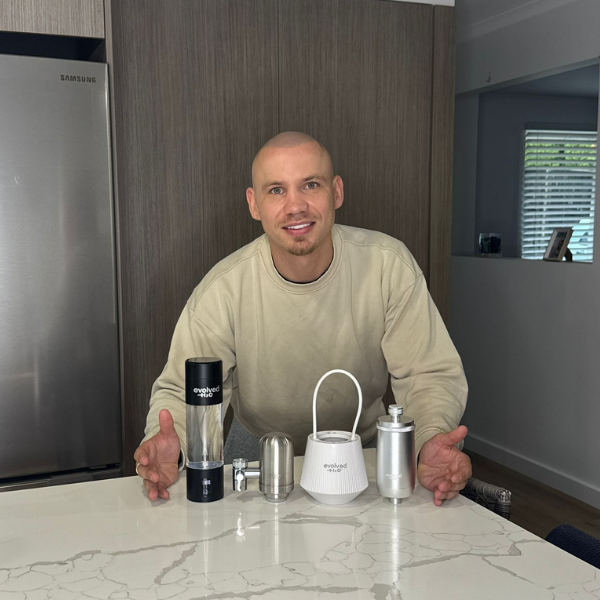
For households that want an additional layer of filtration for their drinking water, the Evolved H2O Glass Water Filter Jug reduces 95.5% of mercury in independent lab tests to NSF/ANSI methods. It is not NSF certified.
Key takeaways
- Mercury does dissolve in water, but the degree depends on its chemical form: elemental mercury dissolves only slightly, while inorganic salts and methylmercury dissolve more readily.
- In major Australian reticulated supplies, total mercury concentrations are typically less than 0.0001 mg/L, well below the guideline value of 0.001 mg/L.
- The Australian Drinking Water Guidelines set the limit at 0.001 mg/L based on health considerations, with particular attention to protecting pregnant women and nursing mothers.
- Food, especially fish and seafood, is the dominant source of mercury exposure for most Australians, not drinking water.
- Cold vapour atomic absorption is the standard laboratory method for measuring mercury in water at the low concentrations relevant to drinking water.
Frequently Asked Questions
Does liquid mercury dissolve in water?
Liquid elemental mercury dissolves only slightly in water. Its solubility at room temperature is very low, around 0.06 mg/L, so most of it remains as a separate liquid phase rather than mixing into the water. Mercury compounds, particularly inorganic salts and methylmercury, dissolve far more readily.
What is the safe level of mercury in Australian tap water?
According to the Australian Drinking Water Guidelines, the concentration of total mercury in drinking water should not exceed 0.001 mg/L. Typical concentrations in major Australian reticulated supplies are usually less than 0.0001 mg/L, well below this limit.
Is methylmercury more soluble than elemental mercury?
Yes. Methylmercury, the organic form produced by microbial activity in sediment, is considerably more soluble in water than elemental mercury. It is also the form that bioaccumulates in fish and aquatic organisms, making seafood the primary dietary source of mercury exposure for most people.
Where does most mercury exposure come from for Australians?
Food is the dominant source. The Australian Drinking Water Guidelines note that the average Australian adult dietary intake of mercury is approximately 0.004 mg per day, with fish and seafood being the main contributors rather than drinking water.
Can a home water filter reduce mercury in drinking water?
The Evolved H2O Glass Water Filter Jug reduces 95.5% of mercury in independent lab tests to NSF/ANSI methods. It is not NSF certified, and actual reduction depends on your water conditions and how the filter is used.
How is mercury measured in tap water?
The Australian Drinking Water Guidelines state that mercury in drinking water is measured using the cold vapour atomic absorption method (APHA 3500-Hg Part B 1992). This is a sensitive laboratory technique capable of detecting mercury at the very low concentrations relevant to drinking water quality.
Sources