Quick answer: According to the Australian Drinking Water Guidelines, turbidity at the consumer's tap should not exceed 5 NTU for aesthetic reasons, and less than 1 NTU is desirable at the point of disinfection. Water below 1 NTU is considered crystal clear. Water at or above 5 NTU may appear slightly cloudy or milky in a glass.

Why turbidity matters in drinking water
Turbidity is a measure of how cloudy or hazy water appears, caused by suspended particles such as fine sediment, silt, clay, algae, or organic matter. It is measured in Nephelometric Turbidity Units, or NTU. The higher the NTU reading, the cloudier the water.
Turbidity matters for two distinct reasons: aesthetics and disinfection effectiveness. Visually cloudy water is unappealing and can signal the presence of suspended material. More importantly, high turbidity can interfere with the ability of disinfectants such as chlorine to work properly, because particles can shield microorganisms from treatment.
The Australian Drinking Water Guidelines provide two separate benchmarks for turbidity, one based on aesthetics and one based on disinfection, and it is worth understanding both.
What the Australian Drinking Water Guidelines say about safe turbidity levels
The Australian Drinking Water Guidelines set clear, practical benchmarks for turbidity. These apply to treated water supplied to households across Australia.
The aesthetic guideline: 5 NTU at the tap
Based on aesthetic considerations, the Australian Drinking Water Guidelines state that turbidity should not exceed 5 NTU at the consumer's tap. At 5 NTU, water appears slightly muddy or milky in a glass. At 60 NTU, it is not possible to see through the water at all. These visual reference points help put the numbers in context.
The disinfection guideline: less than 1 NTU
For disinfection purposes, the picture is more demanding. The Australian Drinking Water Guidelines state that a turbidity of less than 1 NTU is desirable at the time of disinfection with chlorine, unless a higher value can be validated in a specific context. This is because suspended particles can reduce the effectiveness of chlorine disinfection by shielding microorganisms from contact with the disinfectant.
Water described as crystal clear typically has a turbidity of less than 1 NTU, according to the same guidelines.
What about short spikes in turbidity?
Turbidity in treated water does not always remain perfectly steady. Events such as heavy rainfall, catchment disturbance, or changes in source water can cause short-term spikes. The Australian Drinking Water Guidelines note that it is considered best practice to limit these short spikes in turbidity to no longer than 15 minutes.
Does reducing turbidity below 1 NTU keep improving safety?
There is a practical floor to the benefit of reducing turbidity further and further. The Australian Drinking Water Guidelines note that pilot scale trials have demonstrated that a change in filter effluent turbidity from 1.0 through 0.5 to 0.3 NTU would not significantly improve the reliability of pathogen control. In other words, once turbidity is below 1 NTU, pushing it lower does not meaningfully add to disinfection reliability.
How to read turbidity in plain terms
NTU numbers can feel abstract. Here is a simple way to think about them based on the visual descriptions in the Australian Drinking Water Guidelines:
| Turbidity (NTU) | What it looks like | Guideline context |
|---|---|---|
| Less than 1 NTU | Crystal clear | Desirable for disinfection with chlorine |
| Up to 5 NTU | Slightly cloudy or milky in a glass | Aesthetic limit at the consumer's tap |
| 60 NTU | Not possible to see through the water | Well above any acceptable guideline level |
What causes turbidity in tap water at home?
Even when water leaves a treatment plant within guideline limits, turbidity can increase by the time it reaches your tap. Common causes include:
- Ageing pipes and plumbing: Rust, scale, and sediment can dislodge from older pipes, particularly after a period of low flow or following maintenance work on the local network.
- Catchment events: Heavy rainfall can stir up sediment in source water catchments, temporarily increasing turbidity in the supply.
- Disturbed sediment in storage: Water sitting in tanks or hot water systems can accumulate fine sediment that is disturbed when flow resumes.
- Air in the pipes: Milky or white water that clears quickly from the bottom of a glass is often caused by dissolved air, not sediment, and is generally harmless.
If your tap water appears persistently cloudy or discoloured, it is worth contacting your local water authority to report it and ask for guidance specific to your area.
What to consider if turbidity at your tap concerns you
If you notice your tap water looking cloudy or slightly milky on a regular basis, a few practical steps are worth considering:
- Fill a clear glass and let it stand for a minute. If the cloudiness clears from the bottom up, it is likely dissolved air and not sediment.
- If the cloudiness persists or settles as visible particles, contact your water authority and ask whether there is a known issue in your area.
- Check whether your home has older plumbing that may be contributing sediment or rust particles.
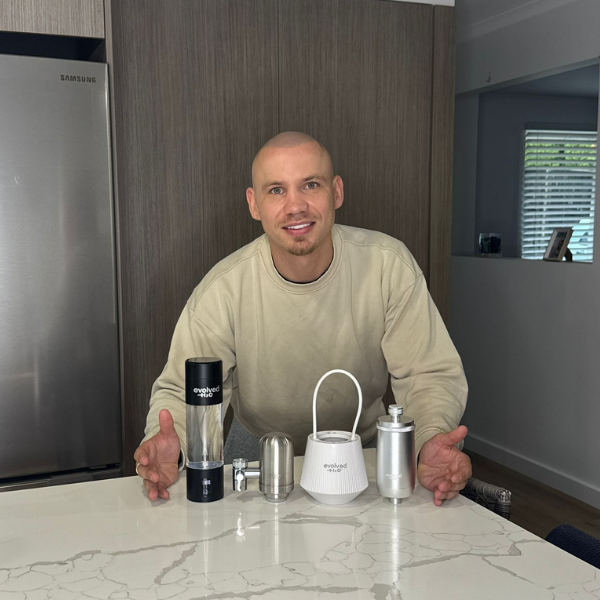
- Consider whether a point-of-use filter at the tap may be appropriate for your household. The Evolved H2O Advanced Tap Filter reduces over 150 common tap-water contaminants, including chlorine, PFAS, heavy metals, microplastics and sediment.
Key takeaways
- The Australian Drinking Water Guidelines set an aesthetic limit of 5 NTU at the consumer's tap: water above this level may appear slightly cloudy or milky.
- Less than 1 NTU is desirable at the point of disinfection with chlorine, as higher turbidity can reduce disinfection effectiveness.
- Crystal-clear water typically measures below 1 NTU.
- Short spikes in turbidity should ideally last no longer than 15 minutes, according to best practice guidance.
- Reducing turbidity below 1 NTU does not significantly improve pathogen control reliability, based on pilot scale trial data cited in the guidelines.
- Persistent cloudiness at your tap is worth reporting to your local water authority.
Sources