Quick answer: Properly treated Australian tap water is designed to contain no detectable E. coli or thermotolerant coliforms. Water authorities test for these microbial indicators to confirm treatment is working. Untreated or compromised supplies can carry bacteria, which is why ongoing monitoring under the Australian Drinking Water Guidelines matters.

What the Australian Drinking Water Guidelines say about bacteria in tap water
Australian tap water is subject to the Australian Drinking Water Guidelines, which set out what microbial indicators water authorities must monitor. The short answer is that compliant treated tap water should have no detectable E. coli or thermotolerant coliforms. The presence of these organisms signals a potential problem with treatment or distribution that needs investigation.
The guidelines use specific indicator organisms rather than testing for every possible bacterium. This is because testing for every pathogen in every sample is not practical, so authorities rely on indicator species whose presence suggests faecal contamination and the possible presence of other harmful microorganisms.
What are thermotolerant coliforms and why do they matter?
Thermotolerant coliforms are a key indicator group used in Australian water quality monitoring. According to the Australian Drinking Water Guidelines, thermotolerant coliforms are a sub-group of coliforms that are able to grow at 44.5 plus or minus 0.2 degrees Celsius. This temperature tolerance is what distinguishes them from other coliform bacteria and makes them useful as indicators of faecal contamination.
Within this group, E. coli is the most significant indicator. The Australian Drinking Water Guidelines note that thermotolerant coliforms that produce indole from tryptophan at 44.5 plus or minus 0.2 degrees Celsius are regarded as being E. coli. In other words, E. coli is identified by a specific biochemical reaction at that temperature, not just by its heat tolerance alone.
Is E. coli in tap water always harmful?
Not all E. coli strains cause illness, but some do. The Australian Drinking Water Guidelines state that while most E. coli are non-pathogenic, there are some pathogenic subtypes that can cause enteric illness, including enteropathogenic, enteroinvasive, enterotoxigenic and enterohaemorrhagic strains. This is why the presence of any E. coli in treated drinking water is treated as a serious concern, even though the majority of E. coli strains are harmless.
The guideline value for E. coli in treated drinking water in Australia is zero detectable organisms per 100 mL. Finding E. coli in a treated supply triggers investigation and corrective action by the water authority.
How is bacteria in tap water tested?
Australian water authorities use standardised laboratory methods to test for microbial indicators. The Australian Drinking Water Guidelines reference two main approaches: the Most Probable Number method, which estimates bacterial concentration statistically from multiple dilutions, and the membrane filtration method, which physically captures bacteria on a filter membrane for counting. Both methods are used to determine whether E. coli or thermotolerant coliforms are present in a sample.
Regular sampling at multiple points in the distribution network is part of how water authorities confirm that treatment barriers are working and that water quality is maintained from the treatment plant to the tap.
What about other microorganisms like Cryptosporidium and Giardia?
Bacteria are not the only microbial concern in drinking water. Protozoan parasites such as Cryptosporidium and Giardia are also monitored because they are more resistant to standard chlorine disinfection than most bacteria. NSW Health states that an absolute 1 micron or smaller filter is necessary to remove Cryptosporidium and Giardia. This is a different challenge from bacterial contamination and requires physical filtration rather than disinfection alone.
Australian water authorities typically use multiple treatment barriers, including filtration and disinfection, to address both bacterial and protozoan risks. The combination of barriers is designed to provide safe drinking water even if one barrier is partially compromised.
Does tap water in Australia typically contain bacteria?
In most Australian urban areas, tap water from a reticulated supply that meets the Australian Drinking Water Guidelines should contain no detectable E. coli or thermotolerant coliforms. However, water quality can vary depending on the source, the treatment process, the condition of distribution pipes, and local events such as heavy rainfall or infrastructure issues.
Private water supplies, tank water, and water from areas without reticulated treatment are more likely to contain bacteria and require additional treatment or testing. If you are on a private supply or have concerns about your local water quality, contacting your state or territory water authority or health department is the appropriate first step.
Filtering bacteria at home
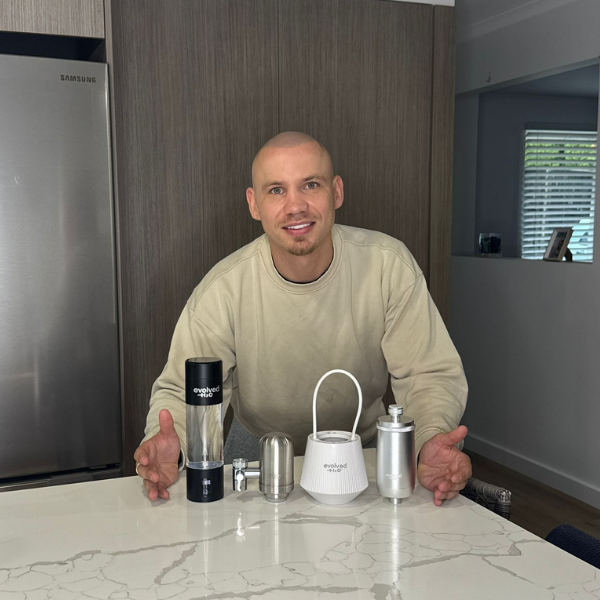
For households that want an additional layer of filtration for bacteria, some home water filters are designed with this in mind. The Evolved H2O Glass Water Filter Jug reduces bacteria. The Evolved H2O Advanced Shower Filter removes bacteria. The Evolved H2O Advanced Bath Filter removes bacteria.
These products address bacteria as part of their filtration function. For questions about microbial concerns specific to your water supply, your state or territory water authority or health department is the right source of guidance.
Key takeaways
- Compliant treated Australian tap water should contain no detectable E. coli or thermotolerant coliforms.
- Thermotolerant coliforms, including E. coli, are used as indicator organisms because their presence suggests faecal contamination.
- Most E. coli strains are non-pathogenic, but some subtypes can cause enteric illness, which is why zero tolerance applies in treated water.
- Australian water authorities use standardised testing methods including Most Probable Number and membrane filtration to monitor microbial quality.
- Cryptosporidium and Giardia require physical filtration of 1 micron or smaller, as they are more resistant to chlorine disinfection than bacteria.
- Private and tank water supplies carry higher microbial risk and should be tested and treated appropriately.
Frequently Asked Questions
Is it normal to have bacteria in tap water?
Properly treated Australian tap water should have no detectable E. coli or thermotolerant coliforms. Some background microbial presence can occur in distribution pipes, but the guideline standard for treated water is zero detectable E. coli per 100 mL. If bacteria are detected, water authorities investigate and take corrective action.
What is the guideline limit for E. coli in Australian tap water?
The Australian Drinking Water Guidelines set the standard at zero detectable E. coli per 100 mL of treated drinking water. This reflects the principle that any detectable E. coli in a treated supply indicates a potential problem with treatment or distribution that requires investigation.
Can bacteria in tap water make you sick?
Most E. coli strains are non-pathogenic. However, the Australian Drinking Water Guidelines note that some pathogenic subtypes, including enteropathogenic, enteroinvasive, enterotoxigenic and enterohaemorrhagic strains, can cause enteric illness. This is why the presence of any E. coli in treated water is taken seriously. This article does not constitute medical advice; consult a health professional if you have concerns.
How do water authorities test for bacteria?
Australian water authorities use two main laboratory methods referenced in the Australian Drinking Water Guidelines: the Most Probable Number method, which estimates bacterial concentration statistically, and the membrane filtration method, which captures bacteria on a filter for counting. Regular sampling across the distribution network confirms that treatment is working.
Are Cryptosporidium and Giardia the same as bacteria?
No. Cryptosporidium and Giardia are protozoan parasites, not bacteria. They are more resistant to chlorine disinfection than most bacteria. NSW Health states that an absolute 1 micron or smaller filter is necessary to remove them. Water authorities use multiple treatment barriers, including physical filtration, to address both bacterial and protozoan risks.
Is tank or private water supply safer than tap water for bacteria?
Generally, no. Private water supplies and tank water are not subject to the same treatment and monitoring requirements as reticulated town water. They carry a higher risk of microbial contamination, including bacteria. If you rely on a private supply, regular testing and appropriate treatment are recommended. Contact your state or territory health department for guidance specific to your situation.
Sources
- Escherichia coli | Australian Drinking Water Guidelines (guidelines.nhmrc.gov.au)
- Drinking water and public health (NSW Health)