Quick answer: In Australia, the acceptable concentration of mercury in drinking water is no more than 0.001 mg/L (milligrams per litre). This guideline value is set by the Australian Drinking Water Guidelines on the basis of health considerations, and is designed to be protective of the most vulnerable groups in the population.

What the Australian guideline says about mercury in drinking water
The Australian Drinking Water Guidelines are clear on this point. According to guidelines.nhmrc.gov.au, the concentration of total mercury in drinking water should not exceed 0.001 mg/L. This is the figure that applies today, and it is the benchmark used by water authorities across Australia when assessing the safety of reticulated supplies.
The same guidelines note that in major Australian reticulated supplies, concentrations of total mercury range up to 0.001 mg/L, with typical concentrations usually less than 0.0001 mg/L. In other words, most tap water in Australia sits well below the guideline limit under normal conditions.
It is worth understanding what 0.001 mg/L means in practical terms. One milligram per litre is equivalent to one part per million. The guideline value of 0.001 mg/L is therefore one part per billion, which is an extremely low concentration. The guideline is set at this level deliberately, to provide a meaningful margin of protection.
How the guideline value was derived
The guideline value for mercury in drinking water was not chosen arbitrarily. According to guidelines.nhmrc.gov.au, the derivation takes into account the broader dietary exposure Australians already have to mercury. The average Australian adult dietary intake of mercury is approximately 0.004 mg per day, primarily from food sources such as fish. The drinking water guideline is calculated alongside this background dietary exposure, so that the combined intake remains within a range considered acceptable on health grounds.
The guidelines also specify that the guideline value should be sufficient to protect pregnant women and nursing mothers, who are at greatest risk from the adverse effects of methyl mercury. This is a significant design consideration: the limit is not set for an average healthy adult in isolation, but for the most sensitive members of the population.
The form of mercury matters here. Mercury exists in several chemical forms, including inorganic mercury and organic mercury compounds such as methyl mercury. Methyl mercury is the form of greatest concern from a health perspective, particularly for developing nervous systems. The guideline addresses total mercury, which encompasses all forms present in the water.
How mercury gets into drinking water
Mercury is a naturally occurring element found in the earth's crust, and low background concentrations can enter water sources through natural weathering of rocks and soils. Industrial activities, including certain mining operations, coal combustion, and the manufacture of some chemicals and electrical equipment, can also contribute mercury to the environment, where it may eventually reach waterways and groundwater.
Once in the aquatic environment, inorganic mercury can be converted by microbial activity into methyl mercury, which accumulates in the food chain. In drinking water specifically, concentrations are generally very low in treated reticulated supplies, as guidelines.nhmrc.gov.au confirms: typical concentrations in major Australian supplies are usually less than 0.0001 mg/L, which is ten times below the guideline limit.
Private water supplies, such as rainwater tanks or bores in areas with historical industrial activity, may warrant more careful monitoring, as they are not subject to the same treatment and testing regime as reticulated supplies.
How mercury concentration in water is measured
Accurate measurement of mercury at these very low concentrations requires specialised laboratory techniques. According to guidelines.nhmrc.gov.au, the concentration of total mercury in drinking water can be determined by the cold vapour atomic absorption method (APHA 3500-Hg Part B 1992). This is a sensitive analytical technique capable of detecting mercury at the very low levels relevant to drinking water assessment.
For households on reticulated supplies, water authorities are responsible for routine monitoring and reporting. If you are on a private supply and have concerns about mercury, contacting an accredited laboratory for testing is the appropriate step.
What this means for Australian households
For most Australian households connected to a reticulated supply, mercury in drinking water is not a day-to-day concern. Concentrations in treated supplies are typically well below the guideline value of 0.001 mg/L, and water authorities are required to monitor and report against this standard.
Households on private supplies, or those in areas with a history of industrial activity, may have different circumstances and should seek specific advice and testing if they have concerns.
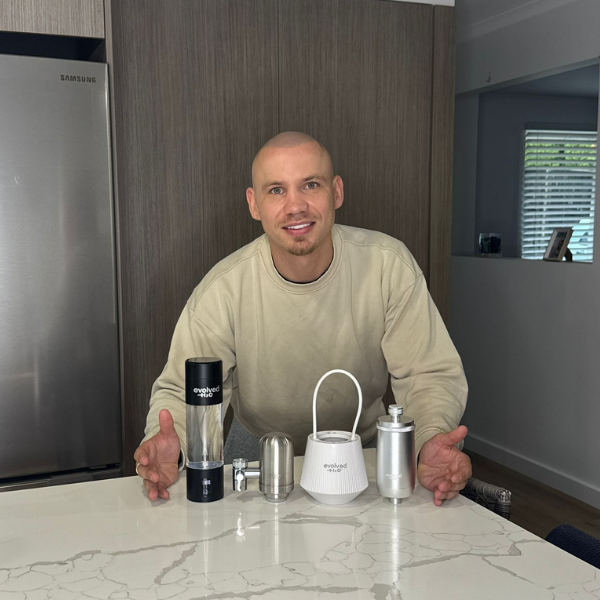
For households who want an additional layer of filtration for their drinking water, the Evolved H2O 3.5L Glass Water Filter Jug reduces mercury by 95.5%.
Key takeaways
- The acceptable concentration of mercury in Australian drinking water is no more than 0.001 mg/L, as set by the Australian Drinking Water Guidelines.
- Typical concentrations in major Australian reticulated supplies are usually less than 0.0001 mg/L, well below the guideline limit.
- The guideline value is designed to protect the most vulnerable groups, including pregnant women and nursing mothers.
- The average Australian adult dietary intake of mercury is approximately 0.004 mg per day, mostly from food; the drinking water guideline accounts for this background exposure.
- Mercury concentration in water is measured using the cold vapour atomic absorption method at accredited laboratories.
- Households on reticulated supplies can check their annual water quality report; those on private supplies should arrange independent testing if concerned.
Sources