Quick answer: Yes, UV light can inactivate E. coli in water. UV radiation at the right wavelength and dose damages the DNA of E. coli cells, preventing them from reproducing. Effectiveness depends on water clarity, the UV dose delivered, and flow rate through the system. UV disinfection does not remove chemical contaminants or particles.

Why E. coli in drinking water matters
E. coli is widely used as an indicator organism in drinking water testing because its presence suggests the water may have been contaminated with faecal matter. According to the Australian Drinking Water Guidelines, thermotolerant coliforms that produce indole from tryptophan at 44.5 +/- 0.2 degrees Celsius are regarded as being E. coli.
While most E. coli strains are non-pathogenic, the Australian Drinking Water Guidelines note that there are some pathogenic subtypes that can cause enteric illness, including enteropathogenic, enteroinvasive, enterotoxigenic and enterohaemorrhagic strains. This is why detecting E. coli in a water supply is treated seriously by water authorities and public health bodies.
Understanding how UV disinfection works, and where its limits lie, helps households and water managers make informed decisions about water treatment.
How UV light inactivates E. coli
UV disinfection works by exposing water to ultraviolet light, typically at a wavelength of around 254 nanometres, which falls in the UV-C range. At this wavelength, UV radiation is absorbed by the DNA and RNA of microorganisms, including E. coli. The absorbed energy causes damage to the genetic material, forming bonds between adjacent nucleotide bases that prevent the organism from replicating. A cell that cannot replicate is considered inactivated and poses no further risk of infection.
This mechanism is physical rather than chemical. No disinfection by-products are introduced into the water, and the water's taste and odour are not affected by the UV process itself.
What affects UV effectiveness against E. coli?
UV disinfection is not a one-size-fits-all solution. Several factors influence how effectively UV light inactivates E. coli in a given water supply:
- Water turbidity and colour: Particles, sediment, and dissolved organic matter in the water can absorb or scatter UV light before it reaches microbial cells. High turbidity significantly reduces UV penetration and therefore reduces the dose delivered to any organism in the water.
- UV dose: Dose is a product of UV intensity and the time the water is exposed to the light. Insufficient dose means some organisms may pass through without receiving enough radiation to be inactivated.
- Flow rate: Water moving too quickly through a UV chamber may not receive adequate exposure time. Systems are rated for a maximum flow rate; exceeding it reduces effectiveness.
- Lamp condition: UV lamps degrade over time and must be replaced according to the manufacturer's schedule. A lamp past its service life delivers less UV output than its rating suggests.
- Lamp fouling: Mineral scale or biofilm on the lamp sleeve reduces UV transmission into the water. Regular cleaning is necessary to maintain performance.
UV disinfection and other waterborne organisms
UV disinfection is effective against a broad range of bacteria and viruses at appropriate doses. However, some organisms are more resistant to UV than others and require higher doses for inactivation. It is also worth noting that NSW Health states that an absolute 1 micron (or smaller) filter is necessary to remove Cryptosporidium and Giardia, which are protozoan parasites that can be present in some water sources. UV at standard doses used in household systems may not reliably inactivate Cryptosporidium oocysts, which is why multi-barrier approaches to water treatment are commonly recommended by water authorities.
What UV disinfection does not do
UV light inactivates microorganisms but does not remove them from the water physically. Dead or inactivated cells remain in the water after UV treatment. More importantly, UV disinfection has no effect on chemical contaminants such as chlorine, chloramine, heavy metals, pesticides, or dissolved solids. It does not reduce sediment, improve taste or odour from chemical sources, or address any non-microbial water quality concern.
UV systems also provide no residual disinfection protection. Once water leaves the UV chamber, there is no ongoing antimicrobial effect. If the treated water is stored in a container that becomes contaminated, UV treatment offers no protection against that subsequent contamination.
For these reasons, UV disinfection is typically used as one layer within a broader water treatment approach rather than as a standalone solution for all water quality concerns.
How E. coli is detected in Australian drinking water
Australian water authorities use standardised laboratory methods to test for E. coli and thermotolerant coliforms. The Australian Drinking Water Guidelines reference two standard detection approaches: the most probable number (MPN) method and the membrane filtration method. These methods allow water quality laboratories to determine whether E. coli is present and at what level, informing decisions about treatment and public health responses.
The guidelines also note that thermotolerant coliforms are a sub-group of coliforms that are able to grow at 44.5 +/- 0.2 degrees Celsius, which is the temperature characteristic used to distinguish them from other coliform bacteria in testing.
Key considerations when evaluating UV disinfection for your water
If you are considering UV disinfection for a household or small-scale water supply, the following points are worth working through before making a decision:
- Know your water source: UV is most relevant for water supplies where microbial contamination is a concern, such as tank water, bore water, or water from surface sources. Reticulated town water in Australia is already treated by water utilities.
- Pre-treat for turbidity: UV systems work best on clear water. If your source water has high turbidity or sediment, a pre-filter stage is typically needed before the UV unit to ensure adequate UV penetration.
- Match the system to your flow rate: Check that the UV system you are considering is rated for the flow rate of your household or application. Exceeding the rated flow reduces the UV dose delivered.
- Plan for ongoing maintenance: UV lamps have a finite service life, typically around 9,000 to 12,000 hours of operation. Factor in lamp replacement and sleeve cleaning as ongoing maintenance tasks.
- Consider what else your water may contain: If your water quality concerns extend beyond microbial contamination to include chemical contaminants, sediment, or taste and odour issues, UV alone will not address those. A multi-stage approach combining pre-filtration, UV, and other treatment steps may be more appropriate.
- Consult your local water authority or a licensed plumber: For water supplies used for drinking, your state or territory health authority or local water utility can provide guidance specific to your area and water source.
Evolved H2O products with a bacteria claim
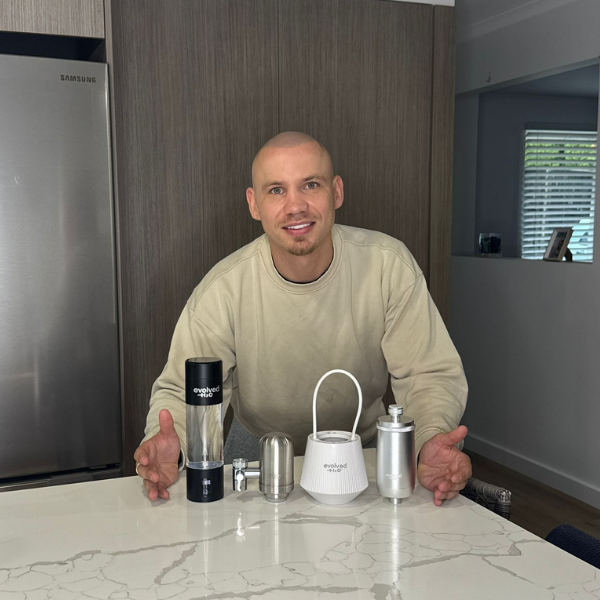
For households interested in filtration products that address bacteria, three Evolved H2O products carry an approved bacteria claim. The Evolved H2O Advanced Shower Filter removes bacteria from shower water. The Evolved H2O Advanced Bath Filter removes bacteria from bath water. The Evolved H2O Glass Water Filter Jug reduces bacteria in everyday drinking water.
These are filtration products, not UV disinfection systems. They address bacteria through their respective filter media and are suited to different household water points. UV disinfection and point-of-use filtration are distinct approaches, and the right choice depends on your water source, the contaminants present, and how you use water in your home.
Key takeaways
- UV light inactivates E. coli by damaging its DNA, preventing the bacteria from reproducing.
- Effectiveness depends on water clarity, UV dose, flow rate, and lamp condition.
- UV disinfection does not remove chemical contaminants, sediment, or dissolved solids.
- Some organisms, including Cryptosporidium, may require additional treatment beyond UV alone.
- E. coli is used as an indicator of faecal contamination in Australian drinking water testing, with detection methods standardised under the Australian Drinking Water Guidelines.
- Multi-barrier water treatment approaches are commonly recommended by Australian water authorities for supplies where microbial risk is a concern.
Sources
- Escherichia coli | Australian Drinking Water Guidelines (guidelines.nhmrc.gov.au)
- Drinking water and public health (NSW Health)
Frequently Asked Questions
Does UV light kill E. coli in water?
Yes. UV light at the right wavelength and dose inactivates E. coli by damaging its DNA so the bacteria cannot reproduce. Effectiveness depends on water clarity, the UV dose delivered, and the flow rate through the system. Turbid or particle-laden water reduces UV penetration and can lower effectiveness.
Is UV disinfection enough on its own for safe drinking water?
UV disinfection addresses microbial contamination but does not remove chemical contaminants, sediment, heavy metals, or dissolved solids. Australian water authorities generally recommend multi-barrier treatment approaches for supplies where microbial risk is a concern. UV is often used alongside pre-filtration and other treatment steps rather than as a standalone solution.
Can UV light remove Cryptosporidium and Giardia?
Standard household UV doses may not reliably inactivate Cryptosporidium oocysts. NSW Health states that an absolute 1 micron or smaller filter is necessary to remove Cryptosporidium and Giardia. For water supplies where these parasites are a concern, physical filtration at that pore size is the recommended approach, often combined with other treatment steps.
Why is E. coli used as an indicator in drinking water testing?
E. coli is used as an indicator because its presence in water suggests possible faecal contamination, which may also mean other harmful pathogens are present. The Australian Drinking Water Guidelines note that while most E. coli strains are non-pathogenic, some subtypes can cause enteric illness, making detection an important trigger for investigation and remediation.
Does UV disinfection affect the taste or smell of water?
No. UV disinfection is a physical process that does not add any chemicals to the water and does not affect taste or odour. However, UV does not address taste or odour issues caused by chlorine, chloramine, or other chemical sources. If taste and odour are a concern alongside microbial quality, additional treatment steps would be needed.
What maintenance does a UV disinfection system require?
UV lamps degrade over time and typically need replacing after around 9,000 to 12,000 hours of operation, regardless of whether they still appear to be lit. The quartz sleeve surrounding the lamp also needs regular cleaning to prevent mineral scale or biofilm reducing UV transmission. Following the manufacturer's maintenance schedule is important for maintaining performance.