Quick answer: In Australia, the guideline limit for total mercury in drinking water is 0.001 mg/L. According to the Australian Drinking Water Guidelines, the concentration of total mercury in drinking water should not exceed this level, based on health considerations.

What is the mercury limit in Australian drinking water?
The Australian Drinking Water Guidelines set a clear standard: the concentration of total mercury in drinking water should not exceed 0.001 mg/L (milligrams per litre). This figure is established on health grounds and applies to reticulated water supplies across the country. The Australian Drinking Water Guidelines are the primary national reference for drinking water quality in Australia, and this guideline value is the benchmark water authorities use when monitoring and reporting on mercury in tap water.
It is worth understanding what 0.001 mg/L looks like in practice. One milligram per litre is equivalent to one part per million. The guideline sits at one-thousandth of that, or one part per billion. This is an extremely low concentration, reflecting the care taken in setting a protective standard for the Australian population.
How much mercury is typically found in Australian tap water?
Measured mercury levels in Australian reticulated supplies are generally well below the guideline. The Australian Drinking Water Guidelines note that in major Australian reticulated supplies, concentrations of total mercury range up to 0.001 mg/L, with typical concentrations usually less than 0.0001 mg/L. In other words, most monitored tap water in Australia sits at around one-tenth of the guideline value or lower under normal conditions.
This does not mean mercury is entirely absent from the water supply. Trace amounts can enter water through natural geological sources, industrial activity, or the breakdown of certain materials. However, the monitoring data reported in the guidelines suggests that Australian water authorities are generally keeping mercury concentrations well within the permitted range.
Why was the guideline value set at 0.001 mg/L?
The guideline value was not chosen arbitrarily. According to the Australian Drinking Water Guidelines, the value was derived through a formal health-based assessment. The guidelines specifically state that the guideline value should be sufficient to protect pregnant women and nursing mothers, who are considered to be at greatest risk from the adverse effects of methyl mercury.
Methyl mercury is an organic form of mercury that can accumulate in the body over time. The guidelines take a precautionary approach, setting the limit low enough to account for the most sensitive groups in the population, not just average adults.
The guidelines also note that the average Australian adult dietary intake of mercury is approximately 0.004 mg per day. This dietary figure is relevant context: it shows that food, particularly certain fish, can be a more significant source of mercury exposure than drinking water for most Australians. The drinking water guideline is set to ensure that water does not add meaningfully to that background dietary load.
How is mercury measured in drinking water?
Accurate measurement is essential for enforcing any guideline. The Australian Drinking Water Guidelines specify that the concentration of total mercury in drinking water can be determined by the cold vapour atomic absorption method (APHA 3500-Hg Part B 1992). This is a laboratory technique capable of detecting mercury at the very low concentrations relevant to drinking water standards. Testing at this level of sensitivity requires specialist equipment and is carried out by accredited laboratories, not by standard home test kits.
If you have a specific concern about mercury in your local water supply, the most reliable step is to contact your state or territory water authority, which is required to monitor and report on water quality against the Australian Drinking Water Guidelines.
What about household water filtration for mercury?
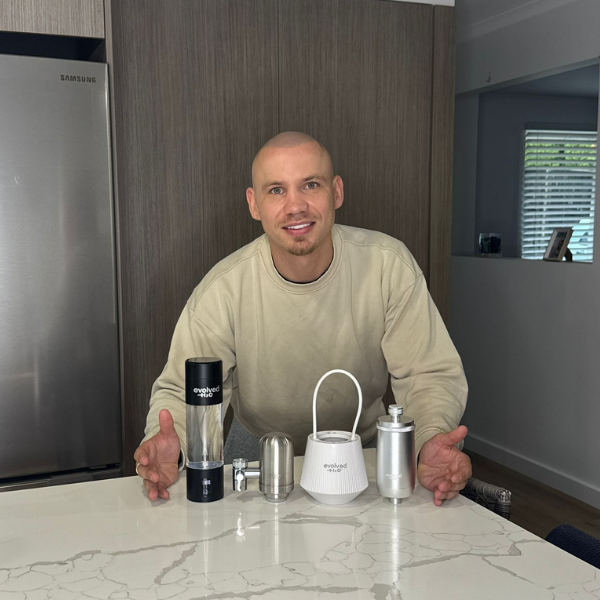
For households that want an additional layer of assurance at the point of use, some water filters are designed to reduce mercury in drinking water. The Evolved H2O 3.5L Glass Water Filter Jug reduces mercury by 95.5%.
This is the only Evolved H2O product with an approved mercury reduction claim. If mercury reduction at the point of use is a priority for your household, the Glass Water Filter Jug is the relevant option from the Evolved H2O range.
Key takeaways
- The Australian guideline limit for total mercury in drinking water is 0.001 mg/L, set on health grounds.
- Typical concentrations in major Australian reticulated supplies are usually less than 0.0001 mg/L, well below the guideline.
- The guideline is designed to protect the most sensitive groups, including pregnant women and nursing mothers.
- The average Australian adult dietary intake of mercury is approximately 0.004 mg per day, with food being a more significant source than drinking water for most people.
- Mercury in drinking water is measured using the cold vapour atomic absorption method in accredited laboratories.
- The Evolved H2O 3.5L Glass Water Filter Jug reduces mercury by 95.5% at the point of use.
Frequently Asked Questions
What is the legal limit for mercury in Australian drinking water?
The Australian Drinking Water Guidelines set the guideline value for total mercury at 0.001 mg/L. This is a health-based guideline, not a statutory regulation in every jurisdiction, but it is the national benchmark that water authorities across Australia use to assess and report on drinking water quality.
Is mercury in tap water a common problem in Australia?
Based on monitoring data cited in the Australian Drinking Water Guidelines, mercury concentrations in major Australian reticulated supplies are typically less than 0.0001 mg/L, which is well below the 0.001 mg/L guideline. Mercury in tap water is not considered a widespread problem in Australia under normal conditions.
Why are pregnant women and nursing mothers specifically mentioned in the guidelines?
The Australian Drinking Water Guidelines note that the guideline value is set to be sufficient to protect pregnant women and nursing mothers, who are considered to be at greatest risk from the adverse effects of methyl mercury. Methyl mercury can accumulate in the body, and the guidelines take a precautionary approach to protect the most sensitive population groups.
Is dietary mercury intake more significant than mercury in drinking water?
For most Australians, yes. The Australian Drinking Water Guidelines note that the average adult dietary intake of mercury is approximately 0.004 mg per day, primarily from food sources such as certain fish. The drinking water guideline is set to ensure water does not add meaningfully to this background dietary exposure.
Can a home water filter reduce mercury in drinking water?
Some point-of-use water filters are designed to reduce mercury. The Evolved H2O 3.5L Glass Water Filter Jug reduces mercury by 95.5%. This is the only Evolved H2O product with an approved mercury reduction claim. For concerns about other contaminants or your specific water supply, contact your local water authority.
How do water authorities test for mercury?
The Australian Drinking Water Guidelines specify that total mercury in drinking water is measured using the cold vapour atomic absorption method (APHA 3500-Hg Part B 1992). This is a specialist laboratory technique capable of detecting mercury at the very low concentrations relevant to drinking water standards. It is not a test that can be performed with standard home kits.
Sources